
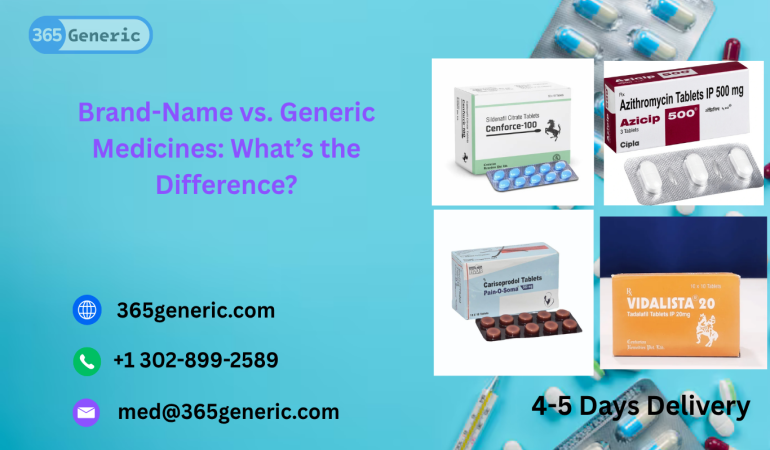
When a healthcare provider gives you a prescription, you may notice that the medication is available under a familiar brand name or as a generic medicine.
For example, Viagra is a brand-name medication containing sildenafil, while generic sildenafil contains the same active ingredient. Similarly, Cialis contains tadalafil, while generic tadalafil is available as a lower-cost alternative.
This can lead to an important question:
Are generic medicines as effective and safe as brand-name medicines?
For FDA-approved generic medicines, the answer is generally yes. Generic drugs must meet specific FDA requirements before they can be marketed in the United States.
However, there are some differences between generic and brand-name medicines that patients should understand.
What Is a Brand-Name Medicine?
A brand-name medicine is a medication marketed under a specific trademarked or proprietary name by a pharmaceutical company.
The company that originally develops a new medication may receive patent and other regulatory protections that provide a period of market exclusivity.
Examples include:
Viagra® — sildenafil
Cialis® — tadalafil
Lipitor® — atorvastatin
Prozac® — fluoxetine
Brand-name medicines may be more expensive because manufacturers may need to recover research, development, testing, manufacturing, and marketing costs.
What Is a Generic Medicine?
A generic medicine is a medication designed to be equivalent to an already-approved brand-name drug.
An FDA-approved generic generally contains the same active ingredient, has the same strength and dosage form, and must meet established standards for quality and performance.
Generic medicines can have different:
- Names
- Colors
- Shapes
- Inactive ingredients
- Packaging
These differences do not necessarily mean the generic medication works differently.
Are Generic Medicines Safe?
FDA-approved generic medicines must meet strict requirements for quality and performance.
The FDA requires approved generic drugs to demonstrate that they are equivalent to the corresponding brand-name product in important ways, including dosage form, strength, route of administration, quality, performance, and intended use.
Generic medicines must also meet manufacturing standards.
For U.S. consumers, this means an FDA-approved generic medication is not simply an untested or lower-quality version of a brand-name drug.
Are Generic Medicines as Effective as Brand-Name Drugs?
Generally, yes.
FDA-approved generic medicines are expected to provide the same clinical benefit as their corresponding brand-name products when used as directed.
For example:
Viagra → sildenafil
Cialis → tadalafil
The generic version contains the same active ingredient responsible for the medication's primary therapeutic effect.
However, patients can respond differently to medications for many reasons. If you believe a medication is not working properly or is causing unexpected side effects, talk with your healthcare provider rather than changing medications on your own.
Why Are Generic Medicines Usually Less Expensive?
One of the biggest advantages of generic medications is their potential cost savings.
Once a brand-name medication's market exclusivity ends and generic competition becomes available, multiple manufacturers may produce the generic version.
Competition can result in lower prices.
Generic manufacturers also do not generally have to repeat all of the original drug's discovery and development process.
As a result, generic prescription medicines can be significantly less expensive than their brand-name counterparts.
Brand-Name vs Generic: Quick Comparison
| Feature | Brand-Name Medicine | Generic Medicine |
|---|---|---|
| Active ingredient | Original active ingredient | Same active ingredient |
| FDA approval | Yes, when approved | Yes, when FDA-approved |
| Effectiveness | Established | Expected to be therapeutically equivalent |
| Appearance | Manufacturer-specific | May look different |
| Inactive ingredients | May vary | May vary |
| Packaging | Brand-specific | Manufacturer-specific |
| Price | Often higher | Often lower |
| Manufacturer | Original/brand company | Various manufacturers |
Why Do Generic Pills Look Different?
You may notice that a generic tablet doesn't look exactly like its brand-name counterpart.
This is normal.
Generic manufacturers may use different:
- Colors
- Shapes
- Imprints
- Coatings
- Fillers
- Preservatives
The active ingredient and required performance standards remain the important considerations.
What Are Active and Inactive Ingredients?
Understanding these terms can make medication labels easier to understand.
Active Ingredient
The active ingredient is the component responsible for the medication's therapeutic effect.
For example:
Viagra → sildenafil
Cialis → tadalafil
Lipitor → atorvastatin
Inactive Ingredients
Inactive ingredients may be used to help create the tablet, capsule, liquid, or other dosage form.
They can include ingredients used for:
- Color
- Flavor
- Stability
- Binding
- Coating
- Preservation
Some people may have sensitivities or allergies to particular inactive ingredients, so tell your healthcare provider or pharmacist about known allergies.
Generic Medicines and U.S. FDA Approval
For U.S. consumers, it is important to distinguish between an FDA-approved generic medication and a product simply advertised as "generic" online.
A legitimate generic prescription drug should come through an appropriate pharmaceutical supply chain and comply with applicable U.S. regulatory requirements.
Consumers can use FDA resources to learn more about approved medications and generic drug standards.
Can My Doctor Prescribe a Generic Medicine?
Yes.
Depending on the medication and applicable prescription requirements, your healthcare provider may prescribe the generic name rather than the brand name.
Your pharmacist may also be able to substitute an approved generic equivalent when permitted by state law and the prescription instructions.
If you specifically need or prefer a brand-name medication, discuss this with your healthcare provider and pharmacist.
Can I Switch From a Brand to a Generic?
For many medications, switching from a brand-name drug to an FDA-approved generic equivalent is routine.
However, you should not switch medications without first confirming the change with your pharmacist or healthcare provider.
This is especially important when:
- You take multiple medications
- You have medication allergies
- You take medicines requiring close monitoring
- Your medication has a narrow therapeutic index
- You have experienced previous medication reactions
- Generic Medicines for Common Conditions
Generic medications are available for many medical conditions, including:
High Blood Pressure
Generic medicines such as amlodipine, lisinopril, and losartan are widely used to manage hypertension.
Diabetes
Generic medications such as metformin are commonly prescribed for type 2 diabetes.
High Cholesterol
Atorvastatin and simvastatin are examples of generic cholesterol-lowering medicines.
Erectile Dysfunction
Generic sildenafil and tadalafil are commonly used prescription treatments for erectile dysfunction.
Infections
Many antibiotics are available in generic forms.
Mental Health Conditions
Various antidepressants and other psychiatric medications are available as generics.
The appropriate medication depends on the patient's diagnosis, medical history, and treatment plan.
Is a Generic Medicine Always the Best Choice?
Not necessarily.
Although generic medicines can provide an affordable alternative, the right medication depends on your individual situation.
Your healthcare provider may recommend a particular brand or formulation because of:
- Medical history
- Previous response to treatment
- Allergies or sensitivities
- Dosage requirements
- Availability
- Insurance coverage
- Formulation differences
The lowest price should not be the only factor when selecting medication.
How to Save Money on Prescription Medicines
If prescription costs are a concern, consider asking your healthcare provider or pharmacist about:
- FDA-approved generic alternatives
- Different dosage forms
- Prescription discount programs
- Insurance coverage
- Manufacturer assistance programs
- Pharmacy price comparisons
- Mail-order pharmacy options when appropriate
Never purchase medication solely because it is unusually cheap. Extremely low prices from unknown online sellers can be a warning sign.
Buying Generic Medicines Online
Online pharmacies can offer convenience, but U.S. consumers should carefully verify a pharmacy before purchasing prescription medication.
Look for a pharmacy that:
- Requires a valid prescription when required
- Provides clear contact information
- Has appropriate pharmacy credentials
- Provides access to a pharmacist
- Clearly identifies the business
- Uses secure payment and website practices
- Provides understandable medication and return policies
Avoid websites that make unrealistic claims, sell prescription medications without appropriate medical oversight, or offer products with unclear origins.
Common Myths About Generic Medicines
Myth 1: Generic medicines are weaker.
Fact: FDA-approved generic medicines must meet established requirements for quality and therapeutic equivalence.
Myth 2: Generic medicines are unsafe.
Fact: Approved generic drugs must meet FDA standards for safety, quality, and effectiveness.
Myth 3: Generic medicines contain completely different drugs.
Fact: A generic medicine generally contains the same active ingredient as its corresponding brand-name product.
Myth 4: Generic medicines always look identical to brand-name products.
Fact: Generic products can differ in color, shape, markings, and certain inactive ingredients.
Myth 5: A higher price means better quality.
Fact: Price alone does not determine the quality or effectiveness of an FDA-approved medication.
Frequently Asked Questions
Are generic medicines FDA-approved?
Many generic medicines sold legally in the United States are FDA-approved. Consumers should verify the source and product rather than assuming that every product labeled "generic" is legitimate.
Are generic drugs cheaper than brand-name drugs?
They are often less expensive because multiple manufacturers may compete after market exclusivity for the brand-name product ends.
Can generic medicine have different side effects?
Because inactive ingredients can differ, some individuals may experience different tolerability. The active ingredient and expected therapeutic effect should correspond to the approved generic product.
Is generic Viagra the same as Viagra?
Generic sildenafil contains the same active ingredient as Viagra and is approved for the same primary use, but it is marketed under the generic name rather than the Viagra brand.
Is generic Cialis the same as Cialis?
Generic tadalafil contains the same active ingredient as Cialis and is approved for the corresponding uses.
Should I ask my doctor about generic medicines?
Yes. If medication cost is a concern, ask your healthcare provider or pharmacist whether an appropriate generic alternative is available.
Final Thoughts
The difference between brand-name and generic medicines is often more about the manufacturer, name, appearance, and price than the medication's active ingredient.
For U.S. patients, FDA-approved generic medicines can provide an effective and more affordable alternative to many brand-name prescriptions. However, medication decisions should always consider your individual health needs, allergies, other medications, and treatment plan.
If you are prescribed a brand-name medicine and want to reduce your medication costs, ask your healthcare provider or pharmacist whether an FDA-approved generic alternative is appropriate.
365 Generic provides educational information to help U.S. consumers better understand prescription and generic medicines. Always consult a licensed healthcare professional before starting, stopping, or changing medication.
Medical Disclaimer
This article is for educational purposes only and does not constitute medical advice, diagnosis, or treatment. Medication availability, prescribing requirements, and substitution rules can vary. Always follow your healthcare provider's and pharmacist's instructions.